

How to facilitate conversations that shape the future we want
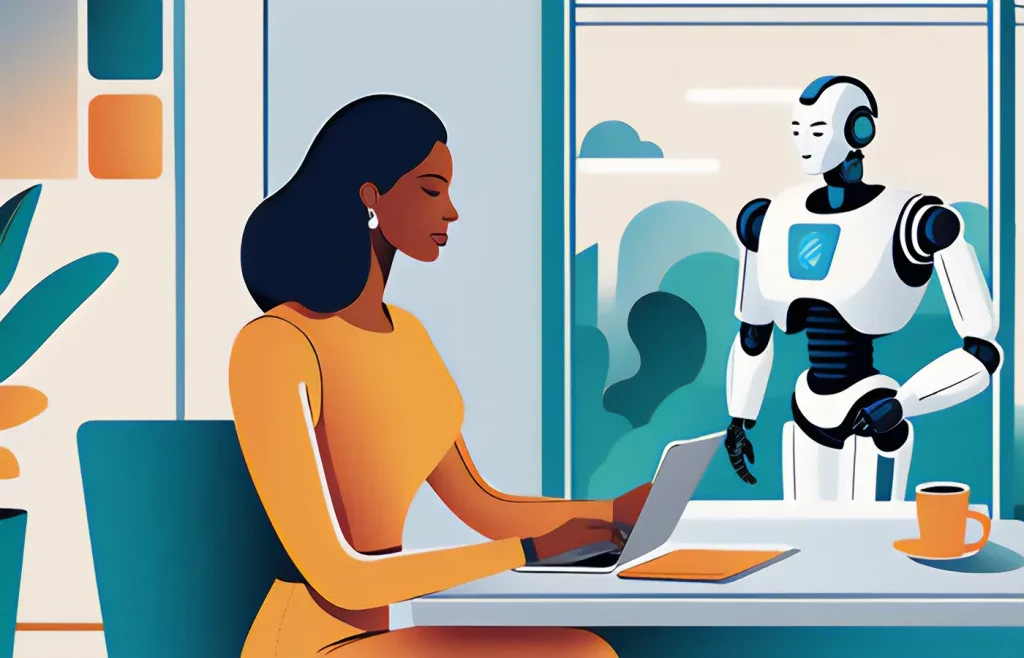
An AI’s interpretation of how it stands ready to help professionals get things done.(Illustration created using Stable Diffusion XL)
Let’s talk today to create the right tomorrow.
Fuelled by capitalism, competition, regulation and technological innovation, we in the West have enjoyed standards of living that have gradually improved since the 1950s – with a few blips along the way.
But the lives we’ve become accustomed to over generations are undergoing some deep and persistent changes. The same technology that helped us get here is now creating a perfect storm that will fundamentally redefine how we live and work.
Recognising that this isn’t just another wobble in capitalism’s steady progress, how do we engage positively with new technologies to ensure the future they deliver is a constructive and fair one?
Technology is driving change across every aspect of our lives.
High-speed internet access, powerful mobile devices, cheap cloud storage and intuitive ways of sharing information have enabled our rapid shift to remote and hybrid working, accelerated by the pandemic.
The same technologies have meant the rapid decline of traditional media, giving everyone an unlimited number of channels to share their points of view. Ironically, rather than exposing people to a greater number of diverse views, it has enabled us to retreat into our own individually-tailored information bubbles, where divisive, incomplete or incorrect views can flourish.
As if that wasn’t enough change… enter artificial intelligence. While research into AI has gone on for decades, Google’s 2017 research paper Attention Is All You Needintroduced a new way of creating large language models which kicked off the current ‘AI revolution’. In the last 12 months, since businesses like OpenAI added front-ends that make it easy to interact with those models – incredibly, ChatGPT came out less than a year ago – AI has already disrupted the way we work. It follows that it will soon be doing much of the work that currently occupies millions of professionals.
It’s already being applied in fields as diverse as customer service, legal research, the arts, financial analysis and medical diagnosis. As we build more information-rich models that describe more aspects of the world we’ve created, and as the underlying technologies get better and better, few knowledge-based jobs will be immune.
In other words, for the first time, white collar workers are being threatened by technology.
Even those working on AI don’t know what it can actually do.
With a mix of excitement and horror, those working on AI technology admit that even they don’t fully understand what current models are capable of, let alone what comes next.
Researcher Simon Willison refers to models like OpenAI’s GPT-4 as “alien technology” because – despite having created it – we’re only slowly figuring out its full capabilities through trial and error (or, as Simon puts it, ‘poking at it with sticks’).
We already know that AI is not perfect. The technology didn’t appear out of the ether – it was created and fed by human beings, and it’s been imbued with flaws and biases.
As it takes on roles informing decisions in business, government, and society, the biases and blind spots baked into the algorithms could lead to unintended and harmful outcomes, if not addressed now. There’s also the danger that AI could enable the generation of false and misleading information on an industrial scale, going far beyond what we saw during the Brexit referendum and the US presidential election.
We can take control of the conversation.

“Law and Equity, or A Peep at Nando’s” (1787) shows the interior of Nando’s Coffee House in London (image expanded using Adobe Generative Fill from the public domain original)
So, in this climate of disruption and uncertainty, the need for open and diverse discussion is more important than ever. To make good decisions – both as individuals and as a society – we need diverse perspectives, nuanced debate, and a willingness to listen and learn across ideological lines.
That’s why we are partnering with organisations that are seriously engaging with the discussion about where we go next. One example is our close partnership with Adam Smith’s Panmure House - a forum for social and economic debate here in Edinburgh.
In our view, the companies and institutions that will thrive in this new world are those that can foster open dialogue and pull together new perspectives. We need to revive the spirit of the "fourth estate" and create public forums for free-flowing debate and discussion. In Adam Smith’s time, this was facilitated by coffee houses; more recently, it was represented by the mass media.
Today, technology enables every one of us to be a participant in the fourth estate. As Jello Biafra of punk band the Dead Kennedys once proclaimed: “Don’t hate the media, become the media”. Rather than simply accepting change or complaining when it’s imposed on us, it’s our responsibility to create spaces where we can listen to each other, raise concerns and share ideas about how to create the equitable future we want.
Facilitate change in your own organisation.
If you want to lead change, there are practical steps you can take to make this happen within your own organisation. Facilitation is often the secret sauce in transformation work. Take the time to meet with colleagues from different parts of your business. Get to know the language they use, understand the pressures they’re experiencing. Talk to them and collaborate on paving the way for a new direction of travel. Not everyone takes facilitation seriously, but those who put the work into prioritising and curating it find their efforts pay off tenfold.
What are we doing to promote participation in the debate around artificial intelligence? Well, we’re joining forces with Edinburgh Futures Institute at the University of Edinburgh to curate a series of events around ethics, design and AI. Starting in October, our ‘No Harm Done?’ series will bridge the gap between disciplines like research, design, business and law to reflect on the implications of AI systems and create new, ethical pathways for the technology.

