

Barrier-first thinking - a new approach to inclusion
by Dr Alexa Haynes, Head of Research
and Katherine Snow, Principal Consultant
Intent alone isn’t impactful.
That was the key message at last week’s MRS Equality Summit in London, a brilliant, hopeful gathering focused not just on inclusion, but on equity, justice, and the systems that can make them real.
There’s no shortage of good intentions in the world of inclusion. Too often, though, our efforts can stall at generic awareness campaigns and surface-level metrics.
Businesses put people into rigid boxes that don’t fully reflect their lived experiences. Meanwhile, the systems behind the services we use every day aren’t designed to understand or respond to real customer needs.
Many services are still falling short
The data is stark. As we highlighted in our session, despite the many conversations around Consumer Duty, a report published in March found that 40–65% of vulnerable customers still feel that services don’t meet their needs.
The summit was a place not just to identify the challenges, but to show and tell how organisations are rising to meet them. We were proud to speak alongside Natasha Barnett-Hall from our client NatWest Group, and Grant Broome, founder of Dig Inclusion, which became part of Nile several years ago. Together with the audience, we explored a new strategic approach that’s helping turn inclusion from principle into practice.
At Nile, we call it barrier-first thinking, a more helpful way of thinking that changes your entire approach to inclusion.
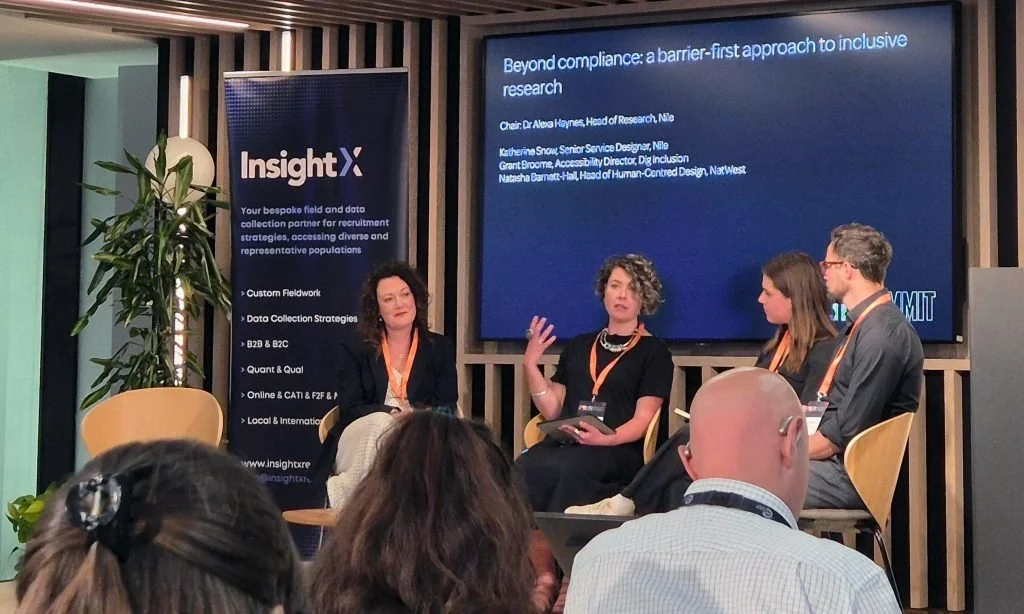
Natasha Barnett-Hall, Alexa Haynes, Katherine Snow & Grant Broome at the MRS Equality Summit
Start with the barriers
Rather than starting by segmenting people – for example into disability types or conditions, which is a well-meaning step but one which often leads to less-than-useful generalisations – we instead start with the barriers themselves.
Whether they’re physical, digital, procedural, emotional or cognitive, barriers can be named, measured, removed: barriers such as access, understanding, or safety.
These can be short-term – like having a stressful day – or longer-term, such as living with a condition. They accept that everyone's circumstances are constantly changing and can leave them facing different barriers. Shifting that perspective moves the responsibility for inclusion squarely where it belongs: onto the organisation.
Barrier-first thinking recognises that human difference is not a challenge to overcome, but a constant to design for. It puts the focus on what an organisation can actually control, and builds in mechanisms to track, act, and stay accountable.
Building on previous concepts
We’ve helped this strategic approach become a key part of NatWest’s accessibility programme and their human-centred design practices in Retail. Barrier-first thinking draws on work done around Universal Barriers, Targeted Universalism, and Generous Exclusion – deliberately focusing expertise on solving the most critical, specific challenges, rather than trying to serve everyone with one diluted solution. (Thanks to Nile associate Leah Lockhart for introducing us to these ideas during the course of our work with NatWest.)
Universal barriers are recurring patterns that explain why services fail for people, regardless of their background or situation. This approach shifts thinking beyond just ‘what do our customers need?’ to also cover ‘what barriers are we unintentionally putting in people's way?’. It focuses on system design issues rather than user characteristics, which results in services that are more accessible and inclusive for everyone. The barrier-first approach at NatWest is helping them focus on the universal barriers customers face in retail, but could be extended across all service lines.
Targeted Universalism recognises that different groups need different strategies to reach the same overall outcome. It means setting goals that apply universally (i.e. to everyone), but creating targeted processes to reach them based on how different groups achieve those goals. Rather than choosing between one-size-fits-all universal policies or divisive targeted approaches, it moves all groups toward shared goals while addressing each group’s specific barriers and circumstances. Once barriers are understood, you can take a Targeted Universalism approach to addressing them.
Generous Exclusion, a concept developed by Priya Parker, intentionally draws a temporary boundary around who to include, to help activate and fulfill the purpose of a product, service or event. Rather than “the more the merrier”, it means thoughtfully limiting who can take part in order to better serve those involved and the overall goal. By closing the door, you cordon off space for more meaningful interaction among those who need it most. Mapping barriers also adds deeper context which helps us have more tangible and effective conversations around inclusion and exclusion.
We’re also seeing this approach fill a critical gap. More and more organisations are involving communities and listening more deeply, which is a hugely positive step. But insight alone isn’t enough. Without the systems to respond – to equip, action, measure and track that insight and impact – things don’t change.
Barrier-first thinking provides that missing link between what people tell us and what we do about it. It helps organisations embed inclusion in the processes they already have, becoming the thread that runs through all design work: projects are scoped around barriers; research seeks to understand them, and design addresses the challenges they create; continuous measurement reveals the positive impacts of reducing or removing them.
Values-led strategy
Outside of our session, the Equality Summit was packed with examples of powerful, practical work. From Dr Mark Thorpe FMRS’s engaging workshop on delivering EDI initiatives within organisations, to Barnardo’s Crowning Glory project, and Lydia Amoah FRSA presenting the latest findings from the Black Pound Report. We were reminded again and again: inclusion isn’t a nice-to-have, it’s foundational and it’s good business. It must be built into everything you do, not added as an afterthought.
It was also clear that values-led strategy matters more than ever. Cultural and political shifts, especially in the US, are changing the landscape. But in the UK, we still have the choice to lead with care, and to embed justice and equity into our organisational systems, not just our rhetoric.
So yes – intention starts the conversation. But understanding and removing barriers? That’s where impact begins.
Interested in what barrier-first thinking could look like in your organisation? We’d love to continue the conversation – drop us a line now.