


01 • THE CUSTOMER NEED
Customers want outcomes, not tasks.
Across a decade of our research, we’ve found customers consistently want reassurance, early warnings and safeguards to stop their finances going wrong.
These features exist, but aren’t joined up. None of them belong to a single product team. Customers are left to find them, switch them on, and do the work themselves. The banks that pull ahead will be the ones trusted to understand and hold the customer’s goals and rules, and act on them automatically across every product.
Mobile banking: the top 6 recurring customer outcomes
1. Reassure me my balance and recent spending are as I expect – “Checking your balance can be quite addictive. I look at it a few times a week, just to check things are roughly where I expect them to be.”
2. Warn me early if I’m going to run short before payday or a bill is due – “We have all our direct debits in there but then we don’t track our day-to-day transactions. Some months we have to dip into our savings to cover our expenses.”
3. Show me where my money goes, sorted automatically so I don’t have to track it myself – “I had to tell it everything I’d been spending and it was just too much hassle.”
4. Help me move money into savings as soon as I’m paid, before I can spend it – “I transfer some of my money into a savings account as soon as my salary comes in.”
5. Let me pay someone knowing the money is going to the right account – “The fact that it checks who you’re sending the money to I think is really helpful, because in case you get one digit wrong.”
6. Let me set my own limits on how my card can be used, without making everyday banking harder – “We sort of want a balance between keeping safe and being easy access.”
(Source: Nile research on mobile and digital banking across retail and business banking customers, 2016-2026.)
02 • THE BANK CHALLENGE
Banks placed the customer at the centre…
then left them holding it all together.
Progress has been real. Digital journeys are easier, apps are faster, servicing is increasingly self-serve. But most improvement has happened inside a product line: current accounts, savings, cards, loans, mortgages, investments.
Between them, the customer still has to do work: moving money to cover a bill, checking whether payday will arrive in time, piecing together what they can afford.
The cause is structural. Each product has its own team, roadmap and targets, but nobody owns the connective tissue between them.
Customers don’t wake up thinking “I’d like a savings proposition today.”
They think in outcomes and decisions:
Can we afford to move house?
Why am I running out of money before payday?
What should I do with the money I’ve built up?
Am I putting enough away for later?
Can I afford to take 6 months off work?
03 • WHAT AI HAS CHANGED
Acting on what customers want, not just what they’ve done before.
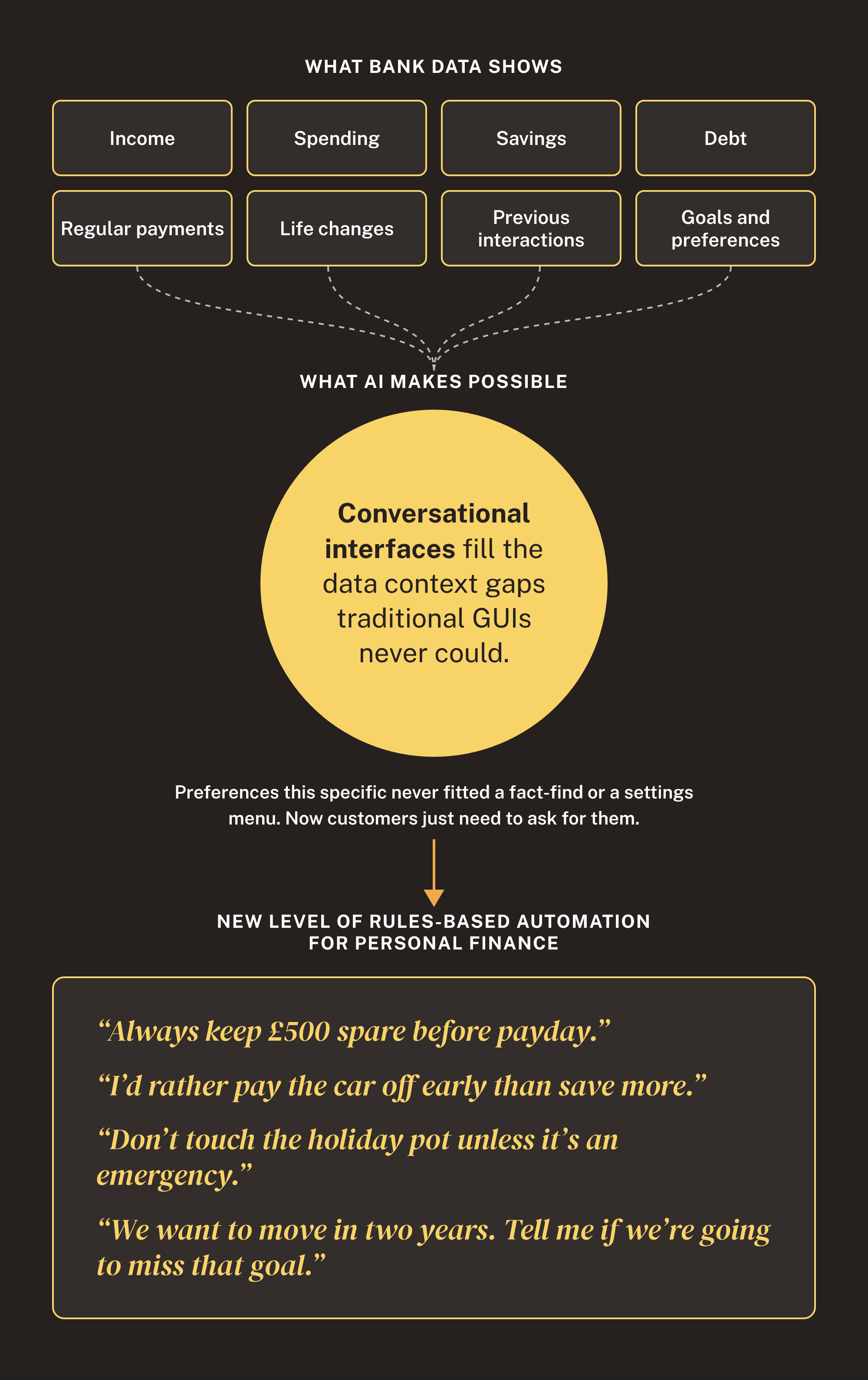
Conversational interfaces fill the data context gaps traditional GUIs never could. Preferences this specific never fitted a fact-find or a settings menu. Now customers just need to ask for them.
04 • CONVERSATION MEETS EXECUTION
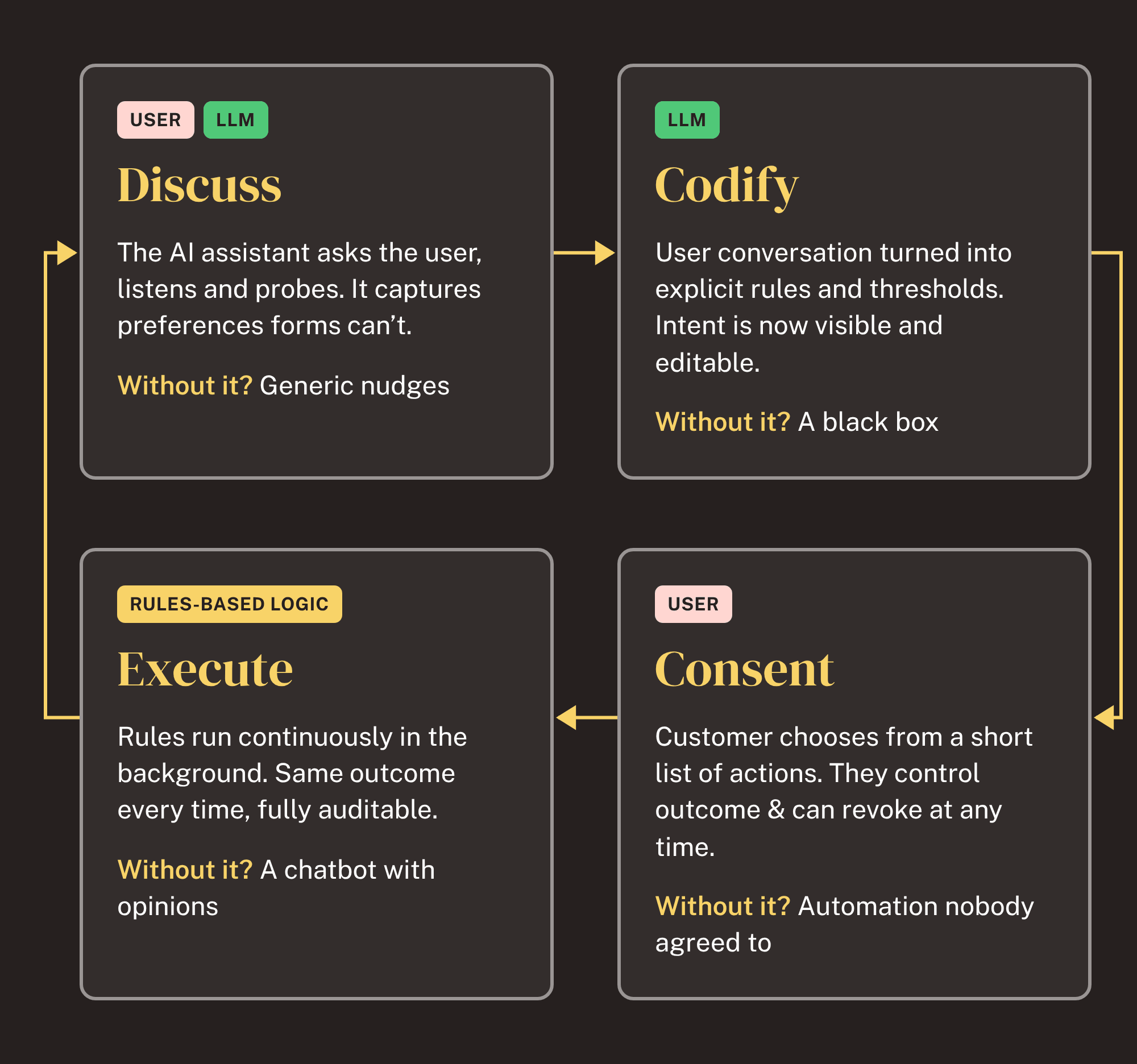
AI asks questions. Deterministic rules move money.
Language models are good at conversations but poor at doing the same thing consistently every time.
Money needs both. So the model shouldn’t make the decision; it should help the customer define the rules that govern it.
Someone has to own those rules.
Under SM&CR, regulators want to know whose name is on them: one accountable senior manager, not six product teams.
05 • OUTCOME-LED EXPERIENCE
The customer sets the rules, and the system works within them.
Before anything acts on your behalf, you agree what matters, in what order, and how far it can act without additional approval.
From settings and permissions: you can switch features on and off. Hope they suit you.
To goals, priorities and rules: say what you want, agree the limits, change them any time.
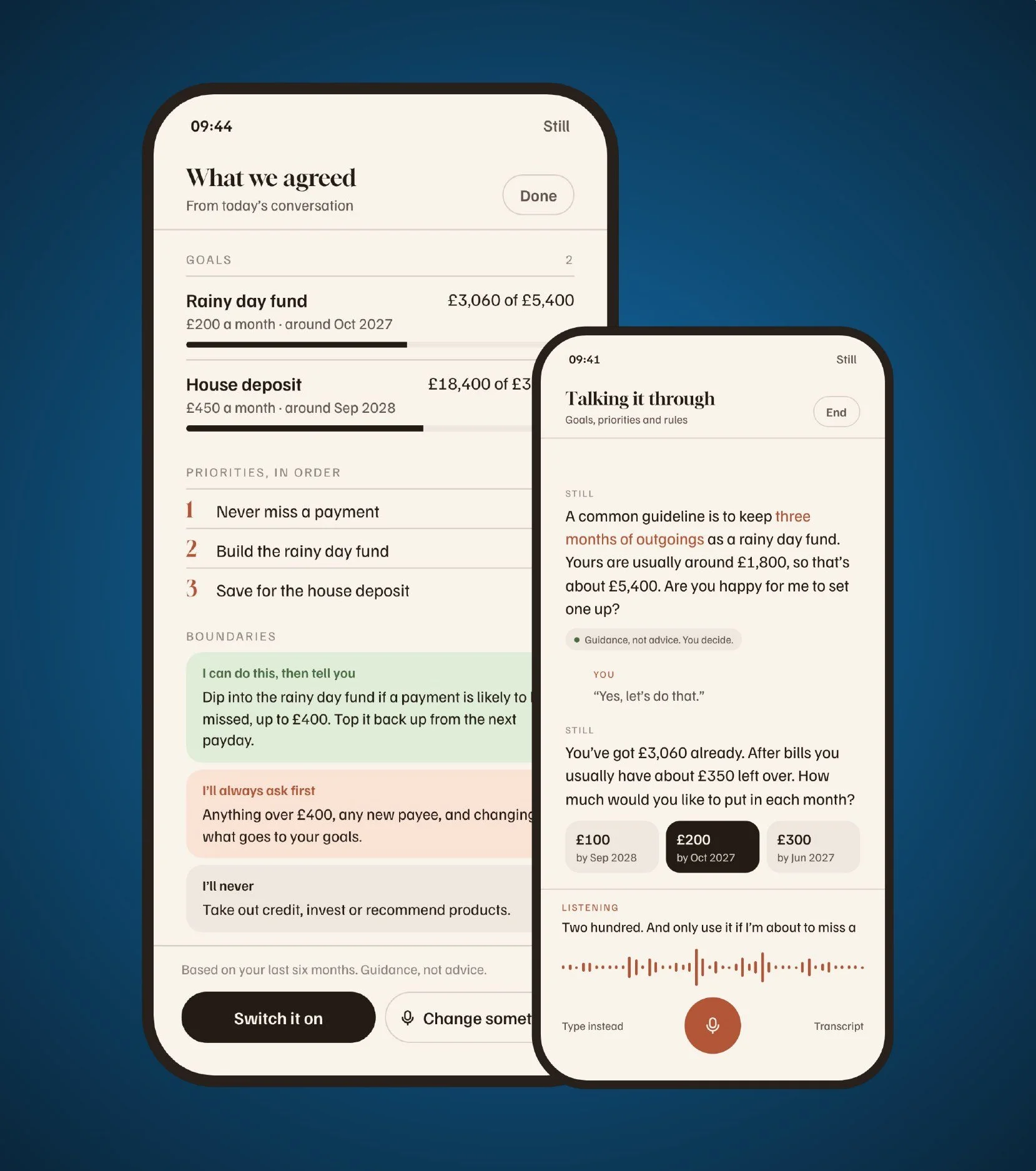
Instead of a menu, the experience becomes an intelligent front door.
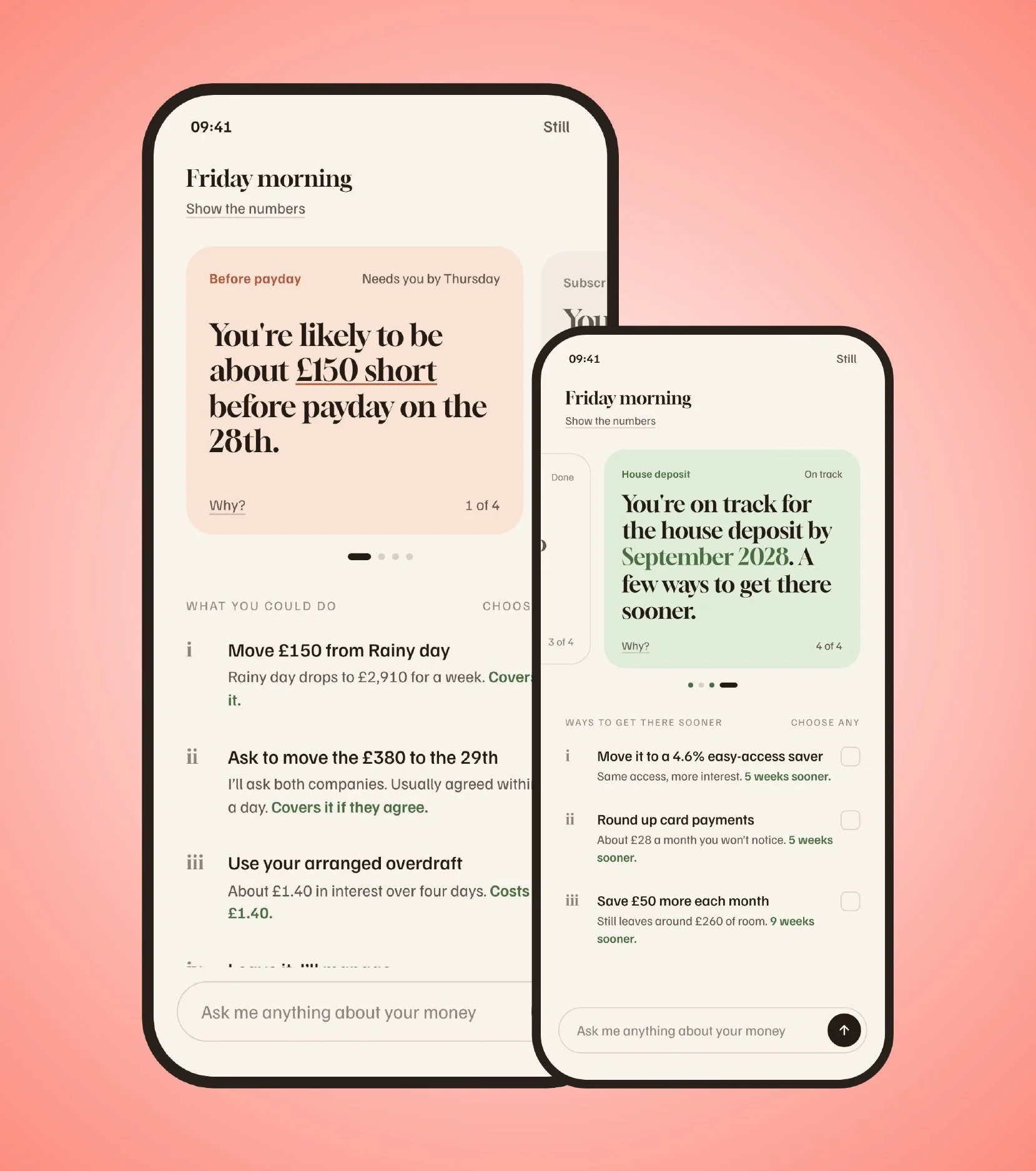
User interactions change from “What would you like to do?” to “Here’s what matters.”
From accounts and products (here’s what you currently hold, work out what it means) to situation, decisions and actions: here’s where you stand, what’s coming up and what to do next.
From logins and sessions (how often your customers need to use the app) to outcomes the app delivered: shortfalls avoided, goals reached, scams prevented.
THE BIGGER RISK ON THE HORIZON
What if customers stop using banking apps altogether?
06 • INVISIBLE ASSISTANTS
The future interface to banking may not actually belong to the bank.
How customers decide – Customers are increasingly turning to AI to understand their money before they turn to their bank. That AI might be a chatbot, or the smartphone itself, which already holds their cards. The first conversation about a financial decision may no longer happen in a banking channel at all.
Market signal: In May 2026, OpenAI launched a US preview of personal finance tools in ChatGPT that connect to more than 12,000 financial institutions, saying over 200 million users already ask it financial questions each month.
What keeps them loyal – When AI can compare and switch on a customer’s behalf, the effort of switching drops to zero and loyalty built on inertia disappears. The relationship moves to what a customer’s agents can compare.
Market signal: FCA research found a fifth of UK adults are already likely to use AI that acts autonomously within pre-set goals, and the rails are live: commercial VRPs launched in June 2026, targeting around 75% of UK current accounts.
How safe customers feel – The same tools that help customers help fraudsters. Scams are becoming more convincing and more personal, so customers will judge their bank less on whether it reimburses them and more on whether it stepped in before the money left.
Market signal: UK Finance reported £1.28 billion in payment fraud losses in 2025, with authorised push payment losses up 19%, driven by investment, purchase and romance scams that criminals now run at scale using AI.
Who’s in control – Your next customer might be a machine. Agents will soon pay bills and move savings on behalf of people. Banks will need to know which agent is acting, what it’s permitted to do, and who’s accountable when things go wrong.
Market signal: In July 2026, HM Treasury’s Financial Services AI Adoption Plan called for a trust framework for agentic payments. Two months later, GoCardless completed the UK’s first agentic account-to-account payment, built through the FCA’s AI Live Testing programme.
Sources: OpenAI, May 2026; FCA, The Mills Review, 2026; UK Payments Initiative, June 2026; UK Finance, Annual Fraud Report 2026; HM Treasury, Financial Services AI Adoption Plan, July 2026; GoCardless, September 2026.
07 • SCENARIO PLANNING
Possible futures. Whose AI will your customers trust?
Regulation will decide how far AI can go. Customers will decide whose AI they let act on their money. Together, those two choices decide what your bank is for.
Explaining someone’s money only needs access to their data, and that already exists. Moving it needs permissions, liability and regulatory cover, which will take longer.
So the risk over the next two years is a slide towards becoming the utility, while your app metrics still look healthy. By 2030, once agents can act, the banks that still hold their customers’ goals and rules will set the terms, regardless of whose agent does the work. The rest become the plumbing.
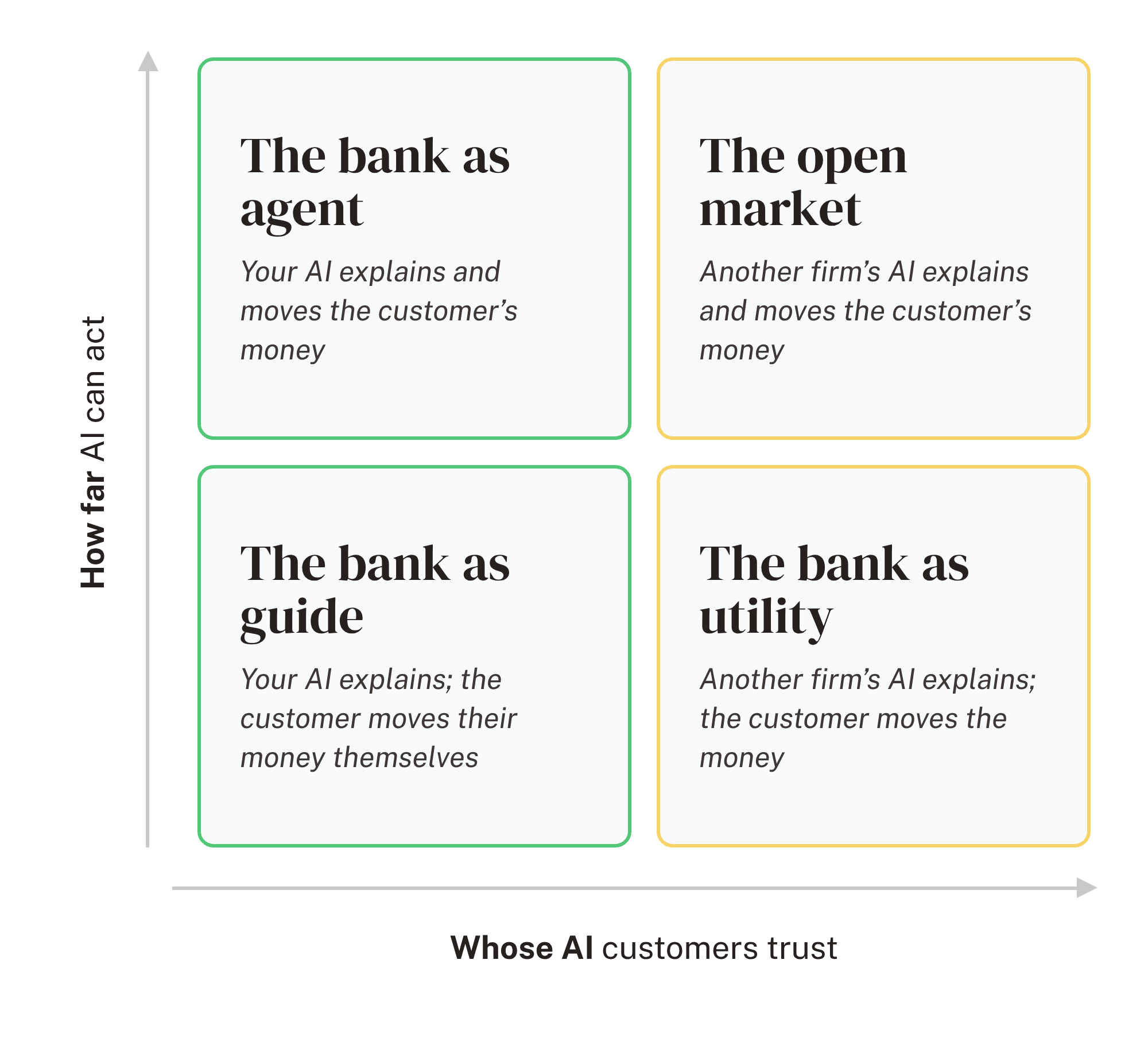
The bank as agent
Your AI explains and moves the customer’s money. You keep the relationship and the data, so long as the customer sees your agent clearly working in their interest.
Risk: customers may lose trust in an agent that won’t recommend a rival’s better product.
The open market
Another firm’s AI explains and moves the customer’s money. Agents compare and switch products. Every bank has to compete on terms a machine can read.
Risk: losing margins that relied on customers not shopping around.
The bank as guide
Your AI explains; the customer moves their money themselves. Customers come to you to understand their money, but your AI only explains, it doesn’t offer options or act.
Risk: they go elsewhere for a straight recommendation.
The bank as utility
Another firm’s AI explains; the customer moves the money. Customers decide elsewhere and use you only to make the payment. You hold their money, not their attention.
Risk: when they next need a product, they start somewhere else.
08 • STAYING RELEVANT
Hold the rules, not just the money.
You can’t out-advise the customer’s own AI. But you can be where their rules live, and you can be the line every agent has to stop at.
1. Become the place customers’ rules live
Customers already tell us the rules they live by, like “always keep £500 spare before payday”. Today no product owns those rules. So start with one that works across the current account and savings, with one named senior manager accountable for it.
2. Let guidance end in clear action
Customers trust their bank to keep their money safe, not always to put their interests first. A product that fits a goal they’ve shared keeps that trust, and one pushed on them for its own sake erodes it. Start from the goal, show fees, access and alternatives, and the next step becomes easy.
3. Make every agent play by the customer’s rules
Whichever AI asks to move a customer’s money, the payment still comes from the bank. Apply their rules to every request, and stop anything they haven’t agreed to. The banks that win will be those who make the agents’ jobs safe as well as effortless.
4. Agree the hard moments in advance
After a job loss or a bereavement, the timing of help matters as much as the help itself. Contact too early feels intrusive, and too late feels like abandonment. Ask customers while things are calm: what should happen if I lose my job, if a payment looks like a scam, or if someone needs to act for me?
09 • THE BUSINESS CASE
You might not own the front door. Make sure you own the outcomes.
Customers will soon ask an agent to sort their money, yours or someone else’s. Every payment still leaves through you. The banks that win will be trusted to hold the goals, the rules and the line between guidance and advice, and to hold any agent to them.
Defend the margin agents will erode – Some income relies on customers not looking: idle savings, avoidable overdraft fees. Agents will look. If your assistant moves the savings, you keep the money and the customer. If someone else’s does, you lose both.
Hold the goals, keep the primary relationship – The bank that holds a customer’s goals is the one they check in with first. It’s where their salary lands, their savings sit and their next borrowing conversation starts.
Cut avoidable call centre demand – Alerting customers before they run low means fewer “where’s my money?” calls, missed payments and cases of arrears. Every problem your app heads off is one your people don’t have to fix.
Reduce scam reimbursement costs – Firms must now reimburse most victims of authorised push payment (APP) scams. In the first 18 months, 88% (£316m) of money claimed back was returned to customers.* Every scam you stop is one you don’t pay for later.
*Source: Payment Systems Regulator, APP scams reimbursement dashboard, July 2026.
Talk to us
If your business is working out what your mobile banking experience needs to become, we’d be happy to talk you through it - whatever your starting point.
A note on our research
Our insights draw on a decade of work with organisations like yours.
1,100+ regulated-sector projects, distilled into anonymised insights.*
3+ projects behind every finding, weighted to the last 18 months.
10 years showing the problems regulated businesses still grapple with.
Fleming is our in-house AI research platform. For this report, we used it to analyse our work by theme. A finding only made it in if it appeared in at least three projects, weighted to the last 18 months. Older work shows where patterns persist. What technology can do today comes from recent programmes.
* We reuse learning, not client data. No client is named and no single client’s figures are shared, except in approved case studies. Fleming is a Nile product our team uses in our own delivery. It does not influence our technology recommendations.